How to Build a Long-Term Digital Marketing Growth Roadmap
Reading time: 9 minutes
Most marketing teams don’t fail because they lack ideas. They fail because they lack sequence. You’ve got a Q3 campaign calendar, a wishlist of SEO fixes, and a Slack channel full of “we should really try TikTok ads” — but no throughline connecting any of it to where your business needs to be in 2028. That’s the gap a growth roadmap closes.
This guide walks through how to build one that survives budget cuts, algorithm updates, and the next shiny-object distraction.
Table of Contents
- Why Most Marketing Plans Aren’t Actually Roadmaps
- The Four Horizons of a Growth Roadmap
- Building Your Roadmap Step-by-Step
- Channel Prioritization: Where to Actually Spend
- Common Roadmap Failures (and Fixes)
- FAQs
- Your Roadmap Forward
Why Most Marketing Plans Aren’t Actually Roadmaps
Here’s the straight talk: a content calendar is not a roadmap. A media plan is not a roadmap. A roadmap connects business outcomes to channel strategy to weekly execution, with checkpoints that force honest course correction.
According to Gartner’s 2026 CMO Spend Survey, marketing budgets now sit at roughly 7.8% of company revenue on average, yet 61% of CMOs report difficulty proving multi-year ROI to their CFOs. That disconnect almost always traces back to planning in quarters instead of horizons.
Quick scenario: imagine you’re a mid-sized SaaS company. You crushed paid search in 2024, watched CPCs triple by 2026 as AI Overviews ate your organic clicks, and now leadership wants “the same growth” with a flat budget. Without a roadmap, you’d panic-shift spend. With one, you’d already have a diversification plan sitting on the shelf, ready to activate.
The Four Horizons of a Growth Roadmap
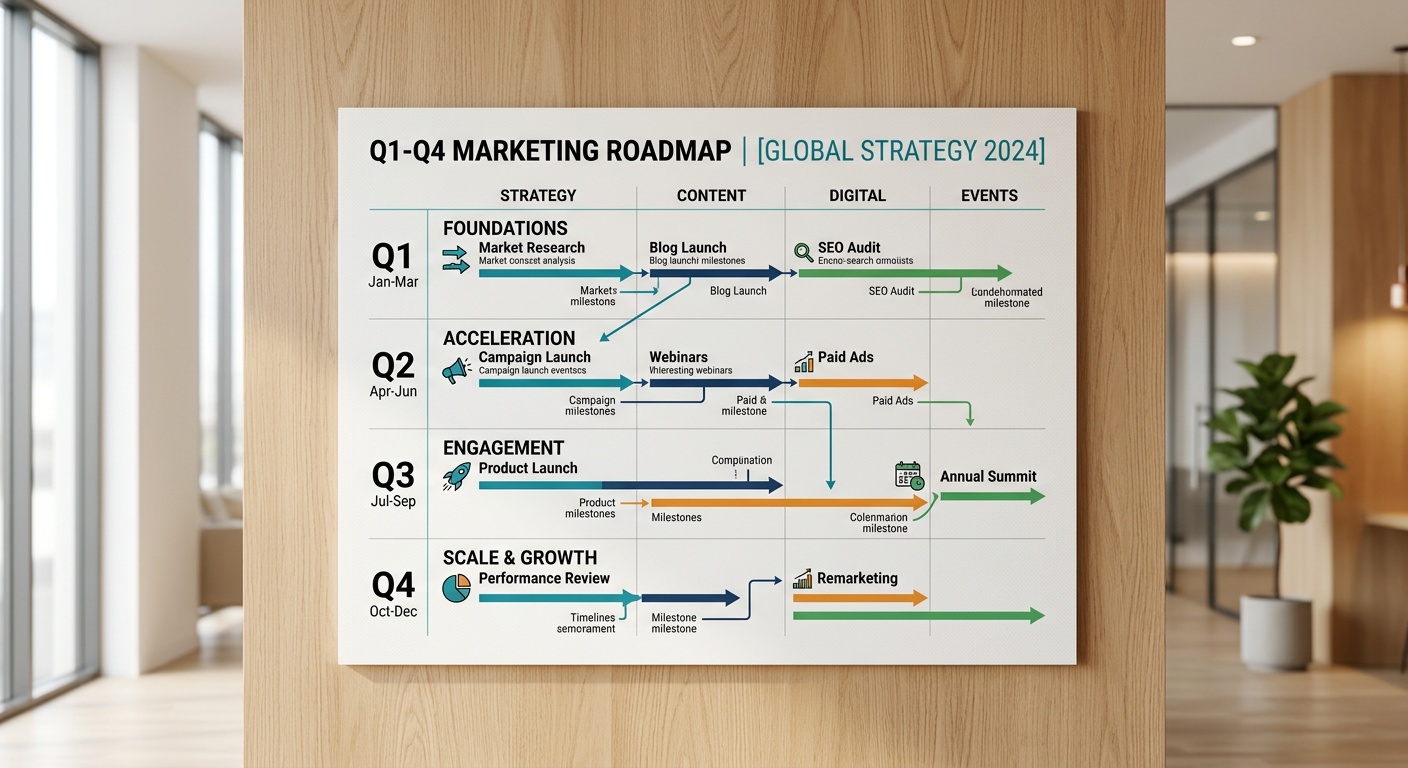
Instead of monthly sprints in isolation, structure your plan across four overlapping horizons:
Horizon 1: Foundation (0–3 months)
Fix measurement, tracking, and technical debt. This is unglamorous work — GA4 audits, CRM hygiene, first-party data collection compliant with 2026’s expanded state privacy laws — but nothing above it will compound correctly if this layer is broken.
Horizon 2: Momentum (3–9 months)
This is where you test channels, build content clusters, and establish repeatable campaign playbooks. You’re proving which levers actually move revenue for your business, not industry benchmarks.
Horizon 3: Scale (9–18 months)
Double down on what Horizon 2 validated. Increase budget on winning channels, build out marketing automation, and start layering brand investment on top of performance spend.
Horizon 4: Compounding (18–36 months)
Owned assets — email lists, communities, proprietary data, brand search demand — start generating disproportionate returns relative to spend. This is the payoff phase most companies never reach because they keep restarting at Horizon 1.
Building Your Roadmap Step-by-Step
Practical Roadmap:
- Anchor to business metrics, not vanity metrics. Pipeline value, LTV, and payback period matter more than impressions.
- Audit your current channel mix against cost-efficiency and audience saturation.
- Set 90-day, 12-month, and 3-year milestones with explicit “kill criteria” for underperforming tactics.
- Map resourcing honestly — a roadmap built for a 12-person team that assumes a 4-person team’s bandwidth will collapse by month four.
- Build quarterly review checkpoints where you’re allowed to change the plan, not just execute it.
Pro Tip: The right roadmap isn’t a document that’s finished — it’s a living decision-making framework you revisit every 90 days without losing the multi-year thread.
Channel Prioritization: Where to Actually Spend
A HubSpot 2026 State of Marketing benchmark found that companies investing in SEO and email as long-term compounding channels saw 2.3x better cost-per-acquisition trends over 24 months compared to those relying primarily on paid social. That doesn’t mean paid social is dead — it means sequencing matters.
Here’s a comparative look at how five core channels typically perform across the horizons above:
| Channel | Time to ROI | Compounding Value | 2026 Risk Level |
|---|---|---|---|
| SEO / Organic Content | 6–12 months | High | Medium (AI search shifts) |
| Paid Search | Immediate | Low | High (rising CPCs) |
| Email / Lifecycle Marketing | 1–3 months | Very High | Low |
| Paid Social | Immediate–3 months | Medium | Medium |
| Community / Owned Audience | 9–18 months | Very High | Low |
Below is a simplified view of where companies are shifting incremental budget in 2026, based on aggregated agency spend reports:
Common Roadmap Failures (and Fixes)
Failure 1: Treating the roadmap as fixed. A furniture e-commerce brand I advised in 2025 built a rigid 24-month plan around influencer partnerships. When platform algorithm changes tanked reach in early 2026, they had no fallback milestone. Fix: build “if-then” branches into each horizon, not just linear targets.
Failure 2: Ignoring internal capacity. A B2B fintech client mapped an ambitious content roadmap requiring 40 articles a quarter with a team of two writers. Fix: roadmap around realistic output, then negotiate for resources based on demonstrated early wins, not projected ones.
Failure 3: No shared ownership across teams. Sales, product, and marketing often chase different definitions of “growth.” Fix: get a one-page roadmap summary signed off by sales and product leadership before execution begins — misalignment discovered in month nine is far more expensive than friction in week one.
FAQs
How long should a digital marketing roadmap actually cover?
Plan in a 3-year arc but execute in 90-day cycles. The long view keeps you from chasing short-term wins that undercut brand or SEO equity; the short cycles keep the plan grounded in real performance data rather than assumptions made a year ago.
What’s the biggest mistake companies make when starting a roadmap?
Starting with tactics instead of business metrics. If you begin with “we need to post more on LinkedIn,” you’ve skipped the step of asking what pipeline, retention, or awareness gap that activity is actually meant to close.
How do I get leadership buy-in for a multi-year marketing plan?
Frame it around risk reduction, not just growth potential. Show leadership what happens if you *don’t* diversify beyond your current top channel — most executives respond faster to downside scenarios than upside projections.
Your Roadmap Forward
Building a growth roadmap isn’t a one-time planning exercise — it’s an operating rhythm that separates teams who compound their marketing investment from teams who restart from zero every budget cycle. As AI reshapes search behavior and channel costs keep shifting through 2026 and beyond, the businesses that win will be the ones with a flexible, horizon-based plan already in motion.
Here’s your practical next-step checklist:
- Audit your last 12 months of channel performance against actual business metrics, not clicks or impressions
- Draft your four horizons with explicit kill criteria for underperforming tactics
- Identify one compounding channel (SEO, email, or community) to invest in disproportionately over the next 18 months
- Schedule your first 90-day review before you finish writing the roadmap
So, where does your current marketing plan actually sit — Horizon 1, or still stuck reacting to last week’s algorithm update? The teams that answer that honestly are the ones still standing in three years.